The prosecutor takes his seat. The defence attorney takes a drink from his glass of water before beginning. Spreading his arms wide he exclaims,
I exist. This is a true statement. It will continue to be true until I cease to exist. There may be varying definitions of existence, perhaps some questions could be raised about the nature of the “I” who claims this existence. Nevertheless the statement remains true. Two points make a line, three points make a plane. 1+1 =2. Mathematics is founded on the principle of true statements. When this concept of certainty was applied to the natural world, lo, we found that nature was governed by rules. We all know Newton’s Laws, or truths if you will. Equal and opposite reactions and the like. Imagine the wonder it must have inspired that every motion, every phenomena that had been relegated to uncertainty, was now explicable. 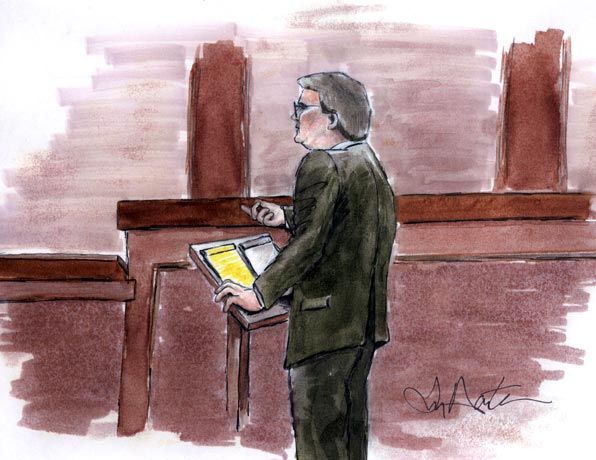 Of course things that happen in the real world have a multiplicity of variables not present in more Euclidean realms of thought. “Nature,” Heraclitus comments, “love to hide.” However our technological mastery makes manifest the power of these truths upon the real world. With each new truth discovered, new possibilities opened. Once we know how things will act, we can take advantage of that predictability. From the discovery of one fact, myriad possibilities emerge. With certain knowledge of thermodynamics, steam power becomes possible. All the sudden we’re moving mountains and traveling faster than a horse. Truths are the framework of every technological advancement.
In much the same way that knowledge of truths allows some degree of control over the natural world. So to, truths can provide some certainty in life. Just as a single law of physics can alter the landscape, so too just one law of humanity, one established truth, can change geography. Just look at what the tabula rasa (the concept that we are all born equally ignorant) did when it caught the imagination of some new world colonists. The funny thing about human truths is that they are not directly evident. Anyone looking objectively at any society can clearly see that people are not equal. This does not make them any less truths. This only means that we have been living lies. That one man is inherently better than another because of his birth, this is a lie told by those in power to those on whom their power depends. Once people knew the truth, they were freed, from within at least. Though many were still enslaved (and still are), armed with this truth, they at least knew that they weren’t slaves by nature, but because of the oppression of others. Social inequality became something that could be changed rather than an unhappy trick of fate. With this truth in hand, great men and women have changed the world. It has been a slow process. The truth is not always easy, sometimes people cannot handle it.
For those who can grasp the truth, the path is solid and the direction is clear. Without truths we’d spend our lives in indecision, swayed by a moments whim. Truth provides certainty, and helps guide our course of action. Once I knew I wanted to teach, the prospect of life seemed far less daunting. Because I knew that I found great satisfaction in teaching, I could aim my steps to becoming a teacher, and, in theory, lead a fulfilling life. This is why religions hold such great sway over people’s lives, they give people truths to live by, they help people get a handle on that tricky game called life. And let us not forget true love, a truth so strong it overpowers all reason. So, whether one wants to build a skyscraper, fly into space, or live a happy life, truths are the handholds of existence.